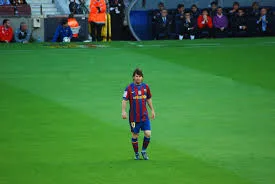
“He’s our neighbour but he’s also the most important player in the world,” says Fernanda, who lives directly opposite where Lionel Messi grew up in Rosario, Argentina’s third largest city. “It’s very powerful and very difficult to fully grasp.”
Indeed, what Messi means to Argentinians has been hard for everybody to grasp over the years, whether they remember him kicking a ball up and down this street as a child or not.
The story of how his reputation among his compatriots has changed over the years is enough for a book in its own right, but one example from the Copa America in July 2011 serves as a perfect illustration of how things used to be.
Messi had won two of his seven Ballons d’Or — and having just won the Champions League for a second time in three years, and third time overall, was on his way to a third that winter. Before Argentina’s quarter-final against Uruguay, the stadium announcer roared into the microphone, “No 10…the best player in the world…Lionel Messi!”.
The reaction was lukewarm.
Next, “No 11…the player of the people…Carlos Tevez!”. The crowd went wild.
And that happened in Santa Fe, another city in Messi’s home region.
It is a different story now, which may be easier to imagine.
“If I answer, I swear I’m going to cry,” Andrea, a teenage fan, told The Athletic after Argentina beat the Netherlands in the quarter-finals of the World Cup. Her voice cracked immediately. “I love him, with all my heart, it’s a very strong feeling,” and she quickly ran out of words.
From worship in the parks and cafes of Buenos Aires to the pride of his barrio in Rosario, to the impassioned chants at a Harry Styles concert, this is the last World Cup for a now 35-year-old Messi, and this is what that means in Argentina.
“This will surely be my last World Cup, the last chance to achieve what we all want to achieve,” Messi said before the tournament kicked off, unintentionally confirming the legacy-defining nature of events in Qatar.
When he says “we”, he means Argentina and its people but thousands of others around the world want Argentina to win this World Cup largely, or fully, because of Messi — a fact Argentinians wear as a badge of honour.
The most obvious example is the thousands of Bangladeshi fans who have celebrated Argentina’s progress to the semi-finals as exuberantly as people in Buenos Aires, and that support has been reciprocated: one man in Rosario got the Bangladesh flag tattooed on his arm in a show of appreciation.
GO DEEPER
‘It can be crazy’ – why Bangladesh is going mad for Messi’s Argentina
“It’s a beautiful thing that so many people who aren’t Argentinian want us to be champions,” Messi said before a ball was kicked at the finals. “I’m grateful for the love I’ve received during my career.”
For many, he is already the best player in the world, but it is almost as if there cannot be global acceptance that he is the best of all time unless, or until, he wins a World Cup. Like Diego Maradona did in 1986.
“We’ve always been incredibly invested in the World Cup in Argentina, and even more so after winning the Copa America in Brazil (last year),” Sergio Aguero, Messi’s former international team-mate and great friend, said last month.
“The hope and expectation is alive again. This World Cup could be the last one for many players, Messi included, and the people expect a lot. Leo is making us dream, and we’ve had five months of news about Qatar on the TV.”
The economic situation in Argentina at present is grim. Annual inflation is predicted to reach 130 per cent by 2023 and the 1,000 peso note, the largest in circulation, is barely enough to get you an empanada (a spicy pastry snack) and a cup of coffee.
Even so, the Argentina home and away shirts for this World Cup, both the regular fan model and the more expensive player version, are almost completely sold out across the country, even though the cheapest ones cost around $100. If any new stock comes in, it is snapped up quickly. Cheap, unofficial alternatives are flying off the washing lines on which they are displayed at the multitude of ‘puestitos’ (market stalls), too.
Argentinians refer to that Copa America final victory over host nation Brazil as ‘taking off the backpack’ or, as we would understand it in English, getting the monkey off their backs.
“We came from two Copa America finals lost, a World Cup final lost. The feeling was, ‘We’re never going to win anything’, ‘We won’t win, won’t win, won’t win’,” Argentina head coach Lionel Scaloni explained before the action started in Qatar just over three weeks ago.
Now they believe.
Television build-up to the matches starts three hours early, tables at sports bars — which aren’t the typical way of watching TV sport in Argentina — are fully reserved, and thousands upon thousands of people across the nation are ready to descend on their particular city’s best-known monument to celebrate a victory. There are two television commercials — one for McDonald’s, one for a bread company — that feature the national anthem.
Argentina went into this World Cup on the verge of equalling the world record for most games unbeaten, one behind Italy’s tally of 37 from 2018-21, and the people truly believed they could go all the way.
Fans got up in the early hours to get ready for their opening group game against Saudi Arabia, which kicked off at 7am Buenos Aires time. Messi scored to put them 1-0 up and then… they lost.
“I suffered a lot,” goalkeeper Emiliano Martinez said following the shock 2-1 defeat. “I talked with a psychologist because they had two shots and I conceded both. I have 45 million Argentinians behind me and I should have given more.”
“My family were there,” Messi said. “They are with me and the truth is that they suffer a lot. The children were bad — Mateo was crying and doing the sums.” — to see how Argentina could still qualify, or be knocked out.
The equation was simple: had Argentina also lost to Mexico in their second game four days later, they would have been eliminated. Their 2-0 victory that night merely kept them alive.
Perhaps the most obvious insight into the stress that players and staff were under was the sight of Pablo Aimar, Scaloni’s assistant and a fellow former Argentina international, crying his eyes out on the bench after Messi struck the opener.
Scaloni cried too.
“If somebody doesn’t identify with these players it’s because they really don’t care about the national team,” he said later. “It’s not the same to play in this shirt as it is with any other, that’s just how it is.”
Imagine carrying the hopes of this nation.
If you tell anybody in Buenos Aires you’re going to Villa Fiorito, the impoverished barrio where Diego Maradona grew up, they will tell you to be careful, and to not go at night.
If you brave it anyway and tell the people of Villa Fiorito, with their fearsome reputation, you’re going the almost 200 miles (300km) up to Rosario, Messi’s hometown…forget it.
Rosario is, by almost every account, a dangerous place.
Some areas are worse than others, but you’re warned to be careful even in the city centre. The homicide rate is four times the national average, the result of battles between drug cartels. Before Argentina played the Netherlands in the quarter-finals on Saturday, a local TV news station was broadcasting live from the city’s biggest sports bar, it showed fans travelling in a car decked out in Argentina memorabilia, and the story of a 60-year-old man who had been killed in the latest shooting.
Many shops and restaurants require you to ring a buzzer before you can enter the premises. There are some convenience stores you can enter freely, but more often than not they are barred up completely so customers need to ask for the products they want to buy at the door.
Locals tell you to watch over your shoulders because robberies are common, and that many people are leaving the area. It wasn’t like this a decade ago, but it’s the reality now.
And the heat! Temperatures regularly reach 40C (104F) or more and the humidity is stifling. Even the breeze is warm.
It should be said, at the risk of making it sound like Hell on Earth, that the only problems The Athletic ran into during four days in town were some sweaty T-shirts, but the presence of a security guard at a Starbucks gives an idea of the alert levels.
Inside that Starbucks, a group of teenage lads from a local school sit around playing cards. Surprisingly, not many of them are big football fans but they nominate Sergio, who is football mad, to explain what Messi means.
“For us, he’s better than Diego,” Sergio says of the Messi/Maradona thing. “Everybody talks about Diego but for us, Messi’s better. Diego is from a different generation, like (1950s and ’60s great Alfredo) Di Stefano.”
But then one lad at the back of the group shouts, “Es pecho frio”— ‘cold chest’, meaning somebody who doesn’t play with passion. How can it be that young lads in Messi’s hometown do not like him, especially now?
If you ask other Rosarinos, the answer is simple.
“Ahhhh, the lad’s a Central fan.”
Where to go next on The Athletic…
Although Messi never played for Newell’s Old Boys, he was registered as a socio at the age of six, played in their youth teams and, in these parts especially, is forever associated with them: the local news channel found a fan in Doha before the Netherlands game who had a flag with Messi and Maradona in Newell’s shirts on it.
In the barrios around where he grew up, lamp posts, telephone poles and even trees are painted in yellow and blue (for Central) or red and black (for Newell’s) to tell you whose territory you’re in.
“We’re very extreme about everything and here in Rosario we have two clubs, Newell’s and Rosario Central,” says Raul Damiani, director at the Malvinas football school, where Messi played at youth level for Newell’s.
“I think that, because of how the city is, with the two different sides, Newell’s fans will support him in everything and maybe the criticism is going to come from the Central fans. There’s that folklore of how football is felt here in Rosario.”
In Messi’s home barrio, La Bajada, the lamp posts are painted sky blue and white, for Argentina. So are the curbs — some have ‘Messi 10’ spray painted on them — and matching lines of bunting hang overhead. His former neighbours got together to dress everything up for the World Cup, including Messi’s house, which lies empty now, save for his brother coming by regularly to keep an eye on things.
“A lot of foreign tourists are coming now, but that’s new,” Fernanda, the lady we met at the start of this piece who lives across the street, tells The Athletic. “This is a common barrio, but Leo has made it a tourist destination. A lot of people are coming here from all over the world. If it wasn’t for him they wouldn’t have any idea about the city.”
On the corner, Fabian, a man in his fifties who has lived on this street his whole life, is painting his gates.
“To me it doesn’t mean too much, because I don’t really like football. But from the point of view that he was our neighbour, left the barrio, triumphed and became a global star, it does make me proud,” he says.
“It’s very strange. I saw him kick a ball around as a tiny kid and now he’s king of the world.”
Two boys lie on their bellies on the opposite corner, rolling around, slapping each other and playing cards. When asked what Messi means to them they laugh and continue messing around, before one says, “Orgullo.” Pride.
La Bajada is one of the more dangerous barrios, locals say. Fine to visit during the day, but not at night — there aren’t many street lights, for starters. But, like in Maradona’s Fiorito, everybody The Athletic encounters there is extremely kind, and there is a great sense of togetherness.
In Fiorito, Maradona’s first home is decorated with a mural of the legendary No 10, as is the house opposite. A dusty football pitch nearby has two murals, one featuring Messi as well, but by and large it would be hard to realise where you were if you walked along the other streets.
In La Bajada, there are more than 30 Messi murals. The words, ‘Messi 10, from another galaxy and from my barrio’ are written on the wall around the pitch where he used to play, less than 100m (109 yards) from his home. On the other side of the road there’s another, stretching out across a wall that’s nearly 100m long itself. That one is next to a giant mural depicting Messi as a child.
Last week, a new one went up on the side of his house.
“The other day, the people who did the mural said to us that seeing this barrio, they understand Leo’s personality better,” Fernanda says. “It’s a very calm neighbourhood, the people are very nice, and that’s reflected in his way of life. I think we see ourselves in him. In that sense, we’re part of his story and that gives us so much pride.”
His old school, on the other side of a vast patch of dried-out grass, is another hotspot on the ‘Circuito Messi’. On the walls of the playground there is another Messi mural, and another decorates a water tower outside. Behind it is one of the more famous ones, also entitled ‘From another galaxy and from my barrio’, painted in 2016.
“He still has his accent,” says Andrea Sosa, who was his teacher at the age of 11. “We have a particular way of talking here in Rosario. It’s been a long time since Leo moved away (to join Spanish giants Barcelona at 13) but he still speaks the same as the rest of us. He’s another Rosarino out in the world.”
Rosario is a three-hour drive north west of Buenos Aires, in the region of Santa Fe, an area known as ‘el interior’.
Santa Fe is a proud sporting region; Angel Di Maria and Angel Correa, two of Messi’s team-mates in Qatar, are ‘Santafesinos’, as is Scaloni, the manager. In fact, he is the fourth Santafesino in a row to manage Argentina. Marcelo Bielsa, who took them to the 2002 World Cup, is another. So is Jorge Valdano, scorer of Argentina’s second goal in the 3-2 win over West Germany in the 1986 final.
“Buenos Aires is like the centre of the country, it’s where everything happens,” Sosa explains. “If you’re from the interior it’s different to being from Buenos Aires. Life here — at one point anyway — is calmer, whereas there everything is faster. It’s like if it doesn’t happen in Buenos Aires, it doesn’t happen.
“Leo is from Rosario, so that carries its own weight too. He’s from the interior, not the capital. Maradona was from Buenos Aires and they’ll compare them forever, so I think that’s an important part of the story.”
It’s far too hot for training sessions back at the Malvinas football school, closer to the city centre, but given there are 1,200 boys and girls on the Newell’s books, the pitch where Messi began to hone his skills is normally in constant use.
“The fact Messi started his footballing career here is very important for us,” says Damiani. “Every kid who comes here has this dream — to be the next Messi.
“Today, every kid sees a reflection of themself in the best player in the world. They think that if the best player in the world played here, they can follow the same path.”
In the tuck shop, a wiry 10-year-old named Fausto sits watching TV in full Newell’s kit. When asked what Messi means to him, he thinks hard for a good few seconds.
“Amor.”
That love is evident across this country.
Harry Styles played two open-air concerts at Buenos Aires giants River Plate’s Monumental stadium on the weekend of the last-16 win over Australia and Messi songs broke out in the crowd during the show and in the queues to leave the ground afterwards.
As fans gathered at the Obelisco in the heart of the Argentine capital after that 2-1 victory, where he scored the opener and set about running the show, the songs most enthusiastically sung were about Messi, and it stayed that way long into the night. Outside a fan park in the north of the city, fans congregated around a giant inflatable Messi; in the southern part, one fan brought a full-sized door from his house with a picture of Messi on it with him to the celebrations.
It was, of course, the same in Rosario for the quarter-final against the Netherlands, where the crowd at El Monumento Nacional de la Bandera was so large that different sections of it were singing different songs at the same time.
In Ushuaia, the southernmost city in the world and almost 1,500 miles from Buenos Aires, fans put on their coats to celebrate on the corner where San Martin meets 9 de Julio, singing songs about “Los ingleses” (the English) — boat trips leave from there for the Falkland Islands (the Malvinas if you’re Argentinian) regularly. In Mar del Plata, four hours south of the capital, 85,000 people took to the beach to watch on a giant screen.
“For me, when they won the Copa America it was like something changed,” Sosa, Messi’s former teacher, says. “People started to see him as somebody who had won something. He didn’t have Maradona above him anymore — they saw that he could win something as well.”
GO DEEPER
This is Maradona’s Argentina. His presence is everywhere, forever entwined with the World Cup
It is impossible to steal the show from Maradona in Argentina for too long, but as much as the national icon’s presence is still very much felt despite his death just over two years ago, he has taken something of a back seat as this World Cup progresses and the national focus is on the current players.
Think about how often the cameras panned to Maradona in the stands at the past two World Cups, especially in Russia, where his health was cause for serious concern. Of course, at the one before those, in 2010, he was Messi and Argentina’s manager.
When Messi scored against the Dutch on Saturday evening, the television cameras turned to the crowd and picked out his family. It felt… different.
As much as Maradona courted controversy via his words and actions, he often grabbed the attention through no fault of his own, but simply by being there. Now with him not being there, it feels like there is a bit more breathing space, even with all the pressure on the players’ shoulders.
In that sense, Maradona seemed to have been more of a ghost in life than in death.
And there has been time for enjoyment, amid the tension of it all. That Saudi Arabia defeat on November 22 feels like a long time ago.
Last week, Messi joined Aguero’s Twitch stream and captured the attention, and the hearts, of the nation.
“Where are you?”, Aguero asked him.
“In our room,” Messi replied.
“‘Ours’?,” Aguero asked.
“Ours.”
For Argentinians, it was a ‘Who started chopping onions?’. moment.
Aguero is a year younger than Messi and had to retire from football last year due to a heart condition discovered shortly after a move from Manchester City to join his pal at Barcelona, and may well have otherwise been with him in the squad at this World Cup. He and Messi had shared a room on international duty since winning Olympic gold together in 2008 in Beijing, China.
Aguero’s Twitch streams are incredibly popular, and his previous record for a live audience was 80,000 for a chat with Messi in the middle of the COVID-19 pandemic, when they had something of a captive audience. The number last week was 250,000, plenty more afterwards, and a mountain of memes.
It made a welcome change from the sort of attention Messi received during the group stage in Qatar, when Mexico’s world champion boxer Canelo Alvarez challenged him to a fight and legendary Brazil midfielder Zico said he was a leader who doesn’t speak. That all feels like ancient history but it was barely two weeks ago.
It might not be crisis mode anymore for Argentina but emotions are still running high.
National sports broadcaster TyC Sport dubbed his performance against the Netherlands — on and off the pitch — ‘el mas Maradoneano’ (the most Maradona-like) of his career, showing that the other No 10 is never fully out of the picture.
Messi had, after all, not just provided a remarkable assist and scored penalties in normal time and the shootout, but provoked Dutch head coach Louis van Gaal by cupping his ears, approaching him after the game, criticising him in his post-match interviews and also immortalising the phrase ‘Que miras, bobo?’ — What are you looking at, dummy? — by breaking off one media moment to shout it at two-goal Netherlands striker Wout Weghorst.
“How many times did he raise his voice publicly in the last 20 years?,” Scaloni asked rhetorically before the tournament, surely not expecting it to happen any time soon. And it is worth thinking about. He has done so against the Argentina Football Association and struck back at those who had criticised him and the team for losing those three finals, and for his decision not to sing the national anthem (which he now does).
“Argentina is like that, it passes from one extreme to the other very quickly,” Damiani says. “There were lots of times when Messi wasn’t able to enjoy playing for the national team.”
Despite those grievances, Messi has rarely spoken out against an opposition player or manager. It can only be the tension and pressure of this World Cup that provoked those actions at the weekend. He has certainly faced worse provocations in his career, not least those epic battles between Barcelona and Real Madrid.
This is different.
Victory over the Netherlands kept Messi on course for a second World Cup final appearance, having been on the losing side in 2014 (Photo: Julian Finney/Getty Images)
“If I walk down the road, I might get asked for an autograph: one, two, five… by the fifth, I’m not saying no, but…” Scaloni told UK newspaper The Guardian. “That’s once in a while. He’s every single day, every single holy day. It’s not fair that he can’t have a life like all of us. He goes into a dining room (on international duty), everyone’s watching: cook, kit man, everyone. And that’s people who know him. Imagine people who don’t — 365 days, 24 hours.”
It has been turned up another notch in Qatar but despite everything, and while Brazil, Belgium, Spain, Germany, Portugal and England have been knocked out, Messi is having a superb tournament. If he carries on like this and Argentina do win it, it would be reminiscent of Maradona’s heroics in Mexico 36 years ago.
“Messi was Superman and all the other heroes rolled into one,” Argentine paper Diario Olé wrote of his showing against the Dutch.
Today (Tuesday), Croatia — obdurate winners on penalties against Japan and Brazil to get this far — stand between Argentina and another World Cup final; another shot at undisputed immortality for Messi, one final chance to take off the ultimate backpack.
It would be their second final in the past three tournaments, having got there in Brazil eight years ago before losing 1-0 to Germany after extra time.
Croatia did plenty of damage in between, though, beating Jorge Sampaoli’s Argentina side 3-0 in the group stage at the previous World Cup in 2018. Argentina had a torrid tournament in Russia and nine days later were knocked out in the last 16 by eventual champions France, whereas Croatia reached the final — and they don’t look any less formidable this time, either. If Argentina do get past them, they could meet France again in the weekend’s showpiece.
“Lots of countries want Argentina to win the World Cup, because of him,” Andrea, a fan from Buenos Aires said following Messi’s Australia heroics. “All because of him, how he is as a person, his football, his passion.
“Lots of countries want us to win because of him. Only one person can do that. That’s what he means. He’s incredible.”
No pressure, then.
GO DEEPER
Messi and Argentina’s heightened emotions could end up undermining them
(Top photo: Getty Images; design: Sam Richardson. All other photos: Sam Lee)