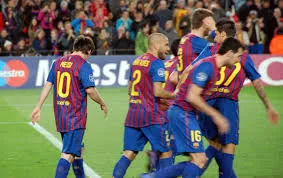
The biggest stars on the planet have flocked to Qatar but if you have spent any time in Doha over the last few weeks or even just absorbed the football on television, you’ll know that one name stands apart from the rest.
Lionel Messi has indicated this will be his fifth and final World Cup with Argentina and his last attempt at securing the holy grail to complete his already glittering career.
Argentinians have travelled en masse, bellowing his name and bowing to their captain at corners, but Messi’s support doesn’t stop there. Fans from Bangladesh, Nepal, North Africa and beyond have all come to Qatar with one ambition; to catch a glimpse of their cult leader in the twilight of his career.
In a special audio documentary for The Athletic Football Podcast, some of The Athletic’s biggest and best explain why Messi’s name is being shouted the loudest, the view back in Argentina compared with Diego Maradona and his complex relationship with Saudi Arabia.
You can listen to the full podcast on Apple Podcasts, Spotify and wherever you get your podcasts, as well as ad-free on The Athletic app. Equally, here is the transcript of the episode…
Abi Paterson (host): Everywhere you go here in Qatar, you’re likely to run into someone, somewhere, wearing a blue and white striped shirt with Messi and the number ten emblazoned on the back of it. If you were playing a drinking game every time you saw one, you’d be dead on day one. In a piece for The Athletic on my experiences at the FIFA Fan festival, I wrote about the area effectively being like a cult with the Argentinean as its God.
And he is the deity here. There’s no question of that. But why Messi? And why not Cristiano Ronaldo? Is it because Barcelona have had a bigger impact than Real Madrid? Is it down to his ties with Saudi Arabia? Or is it simply that Messi is actually the G.O.A.T — the greatest of all time?
I’m going to be talking with fans, commentators and journalists from all around the world to get a view on the phenomenon that is Lionel Messi.
Messi’s 1,000th appearance happened here in Qatar as Argentina took on Australia in the round of 16 and, as Messi tends to do, he marked it with a goal — and a pretty special one at that. Although, as Oli Kay told The Athletic Football Podcast, that kind of goal is just par for the course when you’re Lionel Messi.
Oliver Kay: The quality of that particular goal would probably be in most players’ top ten goals in their career, considering the moment as well as the quality of the goal. I doubt that even makes Messi’s top 100. It might not even make his top 200 in terms of technique.
Paterson: And on the way back from that match, as happens in all of the matches here, the victors are welcomed by quite the party when they got back to their hotel. So how did we get here? How is Lionel Messi having such a multicultural impact on this World Cup? To talk about it more. I went and sat down with the man covering Argentina for The Athletic; James Horncastle.
James Horncastle: I think Argentina fans are very aware that this is the last they will see of him. It’s not confirmed that he would retire after the World Cup, but it does feel very special to be there at every game, which could be his last for his country. And there is this kind of sense of gratitude watching him play. There’s a sense of he owes nothing to anybody. There is this sense that we’re witnessing something that is in its twilight. And, as football fans, we’re all just very grateful for some of the moments he’s provided.
Paterson: One thing that may surprise you is that it’s not just the fans who adore and bow down before Messi. The press box is pretty much a congregation at the shrine of the number ten. The Athletic’s Felipe Cardenas tells me his experience.
Felipe Cardenas: It’s been something that I’ll never forget, to be that close to the circus that is this Argentina national team. It’s an emotional rollercoaster any time you’re around them.
Horncastle: Not to bring this back to the Australia game all the time, but it just felt like such a moment. But the first question to Messi in the press conference was: ‘Lionel, I don’t have a question. I just want to hear your voice’.
And he kind of smiled and just kind of gave an answer. But that’s the kind of reverence that he is attracting and generating.
Paterson: So if you’re not across your South American intercontinental competition, Argentina’s success in 2021’s Copa America was HUGE. And it was the moment where opinion on Lionel Messi went from this…
Horncastle: There’s this perception of Messi as being kind of sphinx-like, inscrutable. You don’t know what his emotions are.
Paterson: To this…
Horncastle: He was the one giving the speech. He was the one motivating people. It wasn’t just Messi as the technical leader who leads by example on the pitch by winning games. It was Messi as a kind of orthodox leader in terms of being the guy that would very much talk to players, be there for players throughout the World Cup. One of the things that’s really surprised me is that he has walked through the mixed zone and spoken to media who he’s not obliged to speak to after every game. Yeah, he has to speak to the rights holders. He doesn’t have to speak to anyone who’s not paying FIFA for access. And yet he’s stopped.
Paterson: And incredibly, when I speak with people from a South American or a Latin persuasion there is the same word that comes up time and again. And it’s this idea that Lionel Messi is humble, that there’s this humility around a man who was deified. And that really, really stuns me.
But Lionel Messi is more than a footballer. And while I can get that view here in Qatar, I’m interested in how he’s viewed back in his home country. Out there in Buenos Aires for The Athletic is Sam Lee.
Messi celebrates scoring against Mexico (Photo: Getty Images)
Sam Lee: So being in Buenos Aires, as you can imagine, a lot of the conversations are just about the World Cup and why they just love him so much. I had a conversation with a girl after the game and I was like: ‘What does Messi mean to you in Argentina?’. She was like: ‘I swear, if if you ask me, I’m going to cry’.
And then she immediately started choking up. And she said a few words about how much she loves him. And then she just couldn’t say anymore. I’d say that’s maybe an exaggerated example, but it’s probably the closest and best way to sum it up.
Paterson: We’re very fortunate here at The Athletic to be able to call on so many different journalists with so many different life experiences from around the world. One such being Felipe Cardenas. He’s part of our American team. He calls it soccer. And I wanted to get a wider South American view on Lionel Messi.
Cardenas: Most countries in South America won’t really debate whether he’s the best player in the world. Maybe slight debates about whether he’s the best player of all time — that will always exist. But anyone in South America, like Colombia, Peru, Brazil, Uruguay; they all have to face Messi during qualifiers. We know him very well and we know that he’s very difficult to to get past. He’s the top player on the continent. Him and Neymar have been one and two for so long. So I think he’s beloved. He’s not a player that really rubs people up the wrong way.
Paterson: Before the World Cup kicked off, much of this discussion in the build up was if this tournament was going to be the final hurrah for Messi and Ronaldo, their probable last dances. On an episode of The Athletic Football Podcast, Carl Anka was asked which of those two players cast a greater shadow over their national teams.
Carl Anka: I had a conversation with Mikel John Obi. He said: ‘You can’t model your game on Messi. Messi is an alien. He’s different. He’s not normal’. There’s been conversation from members of the Argentinean fringe players about how they feel really pressurised because they want to give it to Messi. They want to be the player to give him the trophy. He needs to get this monkey off his back. He’s an offside Gonzalo Higuain goal away from this not being a conversation.
Paterson: Diego Maradona is largely deemed the better of the two Argentineans. He did win the World Cup, after all, almost single-handedly. Just listen to this fan after Saudi Arabia beat Argentina in the opening game here at the Qatar World Cup.
Argentina fan: He’s not Maradona. This generation is very different because they didn’t play for their country. They play for Messi. It’s a huge difference.
Paterson: So what is it that means Messi is constantly overshadowed by his compatriot Maradona?
Argentina fan: For me, because I’m 44 and I think that it’s generational. My generation; the older ones who saw Maradona at the fields… it’s difficult to have another one like him. But the new ones — people in their twenties, their thirties — I think that all of them prefer Messi. But we need to be grateful to have both in the Argentinian team. First of all, a lot of what we see in Messi, Maradona did it first and he had a lot of personality, tons of character. He really would take the team on his back. He was a true leader, a big-time captain for a massive footballing country, and he won that World Cup with a team that was not spectacular.
So that’s the one thing that I think people forget — that was not a spectacular team in 1986 for Argentina. They were unsung. They were not beloved like this team that Messi is on. No one believed in that team and that was something that really motivated Diego Maradona. And that’s why I think to this day he’s just a cultural icon. I think in Argentina they’ll say that Messi is perhaps the best player, but no one will ever top Diego Maradona in Argentina. I just don’t think so.
Messi’s brilliance has earned him a cult-like status (Photo: Getty Images)
Paterson: However, that opinion that Maradona is better… it’s starting to change.
Michael Cox: I think when you look at Maradona’s highlights, he was extraordinary, particularly in World Cups when you read informed opinions. At the time, I think Maradona was probably quite inconsistent from season to season. I think he had periods, probably year-long periods or more where he wasn’t really at it. And I don’t think you can really say that at all with Messi.
Paterson: Michael Cox is The Athletic’s tactics writer. The general feeling among football purists is that Lionel Messi is the better one of the two. So I decided to ask Michael why in his eyes Messi is the Argentinean who is deemed the superior player.
Cox: I think the incredible thing about Messi is there’s basically three things you can do when you get the ball. You can dribble with it, you can pass to a team-mate or you can shoot for goal. And I think Messi is not just world class at all three, but at times he’s been the best in the world at all three. And I think you can probably go back in football history and you won’t find anyone else who has that status. You tend to get great dribblers with an assist or great goal scorers who can do a little bit more. But to be the best in the world at all three I think is really quite unique.
Paterson: Can you describe his technique? What is it that particularly stands out about him?
Cox: I remember hearing a goalkeeper talking about him and saying that he takes really short strides. So it’s quite difficult for goalkeepers to set themselves because they don’t quite know when he’s going to pull the trigger.
The first time I saw him live was in 2011 against Getafe, a fairly low-key 2-1 home victory at the Camp Nou. And the thing that amazed me about him was how quickly he could stop. He could be running at full tilt and then just suddenly freeze. And I think that ability to stop and also his tendency to stand still I think is maybe underrated. He finds space in clever ways by not moving often towards the edge of the area. If everyone else is going in towards the goal, he’ll hang back and just find a pocket of space to finish.
We saw that with the goal he scored against Australia in the second round of this World Cup, where he shouldn’t have been able to find space because everyone knows he’s the danger. And yet there’s something about his ability to find space on the edge of the box that I think is quite special.
Paterson: Now, you possibly thought it was a little bit weird that I mentioned Saudi Arabia as a reason for Messi being so loved here in Qatar. But controversially, Messi is helping to promote the Kingdom (of Saudi Arabia). James Horncastle explains exactly how that’s happening.
Horncastle: It was quite jarring to come back from the Argentina-Saudi Arabia game, to turn on the TV and the first advert was a ‘Visit Saudi’ ad. It was starring Messi and looked like a CGI deepfake of Messi. I just felt very awkward.
Paterson: I’m so glad that James said that because honestly, I was having the exact same thoughts when watching this advert. Just go onto the ‘Visit Saudi Arabia’ website and go to the Messi tab. You’ll see what I’m talking about. It’s weird. And on this subject, one of our most read pieces on The Athletic is entitled He Sold Himself to the Devil – Messi, 2030 and a very uncomfortable deal with Saudi Arabia. Adam Crafton is the author of it and he tells me more about the relationship between these two sides.
GO DEEPER
‘He sold himself to the devil’ – Messi, 2030 and a very uncomfortable deal with Saudi Arabia
Adam Crafton: Lionel Messi’s deal with Saudi Arabia came about in May this year when probably the greatest, most famous footballer on the planet signed this very, very lucrative agreement to promote the state of Saudi Arabia. It’s a really interesting deal because it’s all tied around this idea that Saudi Arabia has this national objective, which they call Vision 2030, and if you look at any kind of government websites or government literature, it describes Vision 2030 as a ‘unique, transformative economic and social reform blueprint that is opening Saudi Arabia up to the world’. Advocates of Saudi Arabia would say that it’s all about closer economic ties with the West, closer cultural ties with the West.
Critics of Saudi Arabia would say that this is all about cleansing an image of Saudi Arabia that has been tarnished by the murder of the Washington Post journalist and dissident Jamal Khashoggi, and also a litany of human rights abuses around the rights of women, for example, in Saudi Arabia and also the rights of LGBTQ people.
Now, this is a particularly interesting deal in the context of a World Cup because there’s likely to be (and these are still to be formally announced), two leading bids for the 2030 World Cup. Now, one of these bids is likely to be a kind of a pan-South American bid, which will be Argentina, Uruguay, Chile and Paraguay. You also have this coalition of Saudi Arabia, Egypt and Greece that’s working on a joint bid. So you have a very peculiar situation where although Messi is not specifically as yet, and there’s no sign of anything to suggest at this point that Messi would be an official ambassador for the Saudi Arabian bid in 2030, Messi is promoting tourism in Saudi Arabia, all of which is linked to the Vision 2030 of Saudi Arabia at the same time.
Paterson: The thing is though, for the fans in Argentina that Sam Lee has spoken with, football comes first and everything else can just wash away after that.
Lee: I don’t think Messi and the Saudi Arabia thing or Messi and anything to do with money and Paris Saint-Germain or whatever is on the agenda of the vast majority of fans here. I’m sure it’s probably the same in in England. Maybe on Twitter, it seems like everybody’s really invested in all the issues. In reality, if you were to go to a fan event, people just want to watch the football. And I think from what I certainly gather here, that is how it is regarding Messi and any kind of other issue because he’s so good at football, so important to this one big passion they’ve all got. It’s one big dream they’ve got of winning the World Cup, but everything else is completely secondary. And if it’s just earning money. I don’t think anybody’s got a problem with that, really, from what I’ve seen so far.
Paterson: So it’s Messi most likely gracing the world stage for the final time and fans from across the globe get their final chance to bow down before him. And this has quite literally happened at matches. So how, regardless of what happens, will he be remembered?
Cardenas: There are players that I’ve spoken to here in Doha. Roque Santa Cruz, the former Paraguay player, he was like: ‘He’s done enough for me to be the best player of all time’.
Fan in Qatar: It is pretty clear now that people do love Messi for what he did. He won the Copa America. That was a huge moment and all I can say for now, because I don’t know how it’s going to go, is that they’re all fully behind him and they really, really want him to do it. He has to win the World Cup. He’s won the Copa America, which is good. But this is the World Cup. This is his fifth World Cup. I was at the 2014 World Cup when he got them to the final but just couldn’t do it. But this time around, I think he can do it.
Cox: Regardless of what happens at this World Cup, I think his place in history is already certain. I think people have their minds made up that he is the best of all time. The only question is the comparison with Maradona. The World Cup feels slightly less important than it once did. I don’t think it really changes anything. I think Messi will still be regarded, whatever happens, as the greatest, or certainly he’s in that conversation with with only one other player. For me, it doesn’t affect his legacy if he doesn’t win the World Cup, I don’t think it matters. I will still see him as the best player I’ve seen.
Paterson: It’s hard to say that there’s been any real substantial damage as a result of the relationship that he has with Saudi Arabia. As long as Lionel Messi continues to provide joy to football supporters on the field, that’s a huge deflection and arguably overshadows a lot of that, rightly or wrongly.
(Top photo: Getty Images)