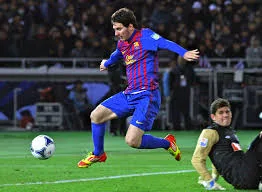
Could Lionel Messi end up at Napoli one day to follow the great Diego Maradona? Tim Clayton/Corbis via Getty Images
A lot has happened since we last spoke: There’s a title race in the Premier League, Italy missed out on qualifying for the 2022 World Cup but the USMNT is going, Barcelona might be back, and Paris Saint-Germain collapsed in the Champions League — again. Given that that pretty much all of that happened over a two-month stretch, a lot will occur again before we next speak. So, if you want a question answered in an upcoming mailbag, you can send me questions on Twitter (@rwohan) or via email to [email protected]. For now, let’s get to the questions that you already asked.
Imagine a soccer version of Tiger returning to the Masters AGAIN. — Austin C.
Love this one. First, let us define what « Tiger returning to the Masters AGAIN » means in a soccer context. For the non-duffers out there, Tiger Woods, arguably the greatest golfer of all time, was in an awful single-car crash last February. It seemed like he was lucky not to lose a leg, would be even luckier to walk again and, well, the possibility of him playing serious golf again wasn’t really worth considering. Fast forward 14 months, and a 46-year-old Tiger not only played in the Masters this past week, but he made the freaking cut and finished the tournament ahead of eight players who are currently ranked in the world’s top 20. It seriously might be the most impressive thing we’ve ever seen from the most impressive golf career we’ve ever seen.
So, uh, we’re not going to imagine some kind of body horror for any current soccer players, but the general outline we’re looking for is « all-time great falls out of the spotlight, comes back out of nowhere as an old man, and beats a bunch of guys from the generation that grew up watching him play. » We’ll start with the all-time great and go with Tiger’s closest soccer competition: Lionel Messi.
While I’ve written about how weirdly irrelevant Messi suddenly became in the week-to-week narrative of European soccer when he moved to PSG this season, he’s still nowhere near as removed from top-tier relevance as Tiger was. Lionel Messi: still pretty damn good!
Best passers in world football pic.twitter.com/IYWWrGMouD
— Gasipo (@gasipo_opinions) April 11, 2022
To fit the Tiger arc, we’re going to need Messi to play in the upcoming World Cup and follow through on what he said about things changing afterward — whether that’s a move back to Argentina or maybe even MLS. He’ll need to play a couple of years out of the European spotlight and also retire from national team duty with Argentina. Then, he’ll need to fully retire from soccer altogether and go live the quiet life that it seems like he’s always yearned for. Then, after a couple of years of raising his kids and getting pulled through scenic mountain streets by his gigantic dog, he’ll decide he needs one last run. Maybe his kids and wife urge him to do it, maybe he kicks a water bottle into a garbage can and realizes, damn, I’ve still got it.
So, at age 42, Messi decides to come out of retirement. Tiger came back to play in the most iconic golf tournament in the world, so Messi would need to evoke some similar romantic notion. Barcelona? No, maybe that would’ve worked if they’d continued their downward economic spiral and fallen into the second division or something, but they’re too big to fail and Xavi has things moving back in the right direction.
Instead, Messi joins Napoli — 10 years after Diego Maradona passed away. The club un-retires the No. 10 jersey for Messi to wear it, and led by an immobile, quadragenarian Messi who can still pass the ball better than anyone else in the world, they challenge for a Serie A title for half of the season before falling short and also make it out of whatever byzantine Champions League group stage structure is in place in the year 2030. They take down Erling Haaland’s Manchester City in the round of 16, then win the first leg against Kylian Mbappe’s Newcastle United in the quarterfinals before falling short, once again. Messi retires after the season.
Other than a dwindling group of people who still have Cristiano Ronaldo avatars on whatever social network people are using at the time, nobody cares about the losses; it’s widely considered the greatest achievement in the greatest soccer career of all time.
To match Tiger’s return to Augusta, that’s all Messi needs to do.
play
1:33
Craig Burley sees so many problems at Manchester United and isn’t sure Erik ten Hag will be able to succeed there.
Would love to know your thoughts on what happened to Ajax in this season’s Champions League: They won every game in the group, looked excellent by pretty much all statistical metrics, including the 538 Elo ratings which I believe had them as the fifth-best team in the world at one point, but somehow failed to overcome a Benfica side they were expected to beat handily. Was it a case of a couple of bad games, or something more fundamental? And, how do you think we should weigh this in evaluating Erik ten Hag as a coach, particularly given it looks likely he’ll be the next Manchester United manager? — Luke J.
I have said before that Ajax were one of the five best teams in the world. They got one of the cushiest draws imaginable — Benfica instead of PSG or Inter Milan or Atletico Madrid — and then just sort of snuck out the back door after surprisingly standing center stage for much of the first act.
The first leg was the big disappointment. Ajax controlled possession and created a ton of chances but then pretty much got ripped apart every time they lost the ball. Even on the road, this team couldn’t fail to beat Benfica — and yet that’s what happened.
Ten Hag’s side then completely dominated the second leg: 16 shots to four, 83% of the final-third possession, 54 touches in the opposition penalty area compared to 17 conceded. Didn’t matter, though. The soccer gods had other plans:
So, Ajax didn’t play as well as the group stage suggested they might, but they were still really unfortunate not to advance. No team plays its best every time; it would be silly to read too much into these two matches to try to say anything about what it might mean for Ten Hag’s theoretical tenure at Old Trafford. If you zoom out a bit, you realize that Ten Hag is actually being considered for the managerial position because he has put Ajax in a position where they can be disappointed to not reach the Champions League quarterfinals.
With much worse talent than he’ll have at United, Ten Hag had Ajax playing the kind of front-foot, field-tilting style that will be necessary if they’re to truly challenge for a Premier League title anytime soon. I’d say that there’s nothing about the particulars of his Ajax tenure that’s concerning. Aside from his age — at 52, he’s one year older than Pep Guardiola, and there might be a tiny red flag in the fact that he hasn’t gotten a top coaching gig until now — the only concerning part is that it all happened at Ajax. Going from being the resource-dominant team in a smaller league to being one of the uber-rich in the richest league in the world is a really big jump that brings all kinds of unpredictable variables into play.
play
1:17
Gab and Juls discuss Newcastle’s decision to sign Chris Wood from fellow relegation candidates Burnley.
Given that Newcastle is (unfortunately) staying up, and that they now have more money than God, what do you think they can do before next season, and who should be worried? I assume UCL/Europa challenging is still a ways off, but do they join the Villas and West Hams and Man Utds of the PL in the hunt for the Conference League? — John M
Newcastle’s January window was surprisingly … restrained? Yes, they spent $112.3 million on transfer fees, but it wasn’t the kind of wild, random money cannon that some expected. They paid $46.3m for 24-year-old Brazilian midfielder Bruno Guimaraes from Lyon, $33m to activate Chris Wood’s release clause to steal him from Burnley, $16.5m to nab 31-year-old full-back Kieran Trippier from Atletico Madrid, and $16.5m for defender Dan Burn from Brighton, while also bringing in 26-year-old full-back Matt Targett on loan from Aston Villa. There’s very little long-term thinking there, right? It’s a bunch of Premier League proven players to immediately fix the defense, a striker from a relegation rival and the one potential star in Guimaraes. These are the moves of a team with a singular goal: Stay in the Premier League.
Newcastle have since vaulted out of relegation trouble, and the signings have had varying effects. Since the start of February, Wood has played 98% of the available Premier League minutes, while Targett and Burn have been on the field 90% of the time. Funnily enough, the two highest profile additions — the England international from the defending LaLiga champs and the talented Brazilian maestro — haven’t played huge roles. Thanks to a foot injury, Trippier has only played 15% of the league minutes since February, while Guimaraes has slowly been accruing more and more playing time but still has only played 45% of the minutes over the past two-plus months.
In other words, the January window at least suggests that Newcastle won’t be completely clueless in this summer’s window. They signed a bunch of short-term players who have immediately played a lot as they’ve risen up the table, and their « One for the Future » has been playing more and more.
So, how good can they get? Well, right now FiveThirtyEight’s model, which takes into account player quality, results, opponent difficulty and underlying performance, rates them as the 14th-best team in the league. That’s progress from Dec. 1, when they were rated as the second-worst. The November arrival of manager Eddie Howe and just a straightforward collection of roughly average Premier League players has completely stabilized things.
The rankings, though, don’t show the degree of difference between Newcastle and everyone else. Their actual FiveThirtyEight rating — which doubles as the percentage likelihood that the team would beat an average side at a neutral site — is 67.1. The 10th-ranked team in the league this year — Brentford! — are rated 72.1, the seventh-rated team (Aston Villa) are 75.8. Manchester United, the sixth-rated team, are 78.3.
For reference, the two highest-rated teams in the world, Manchester City and Liverpool, are rated 93.4 and 93.3, respectively. A title challenge is a long way away from Newcastle, but the gap between sixth and 14th really isn’t that big right now. Given that the Saudi ownership group still haven’t invested much in attackers yet — you know, the most impactful positions on the field — there’s a ton of room for improvement even just for next season. I’d be surprised if they don’t play like a top-10 team in 2022-23, and it wouldn’t shock me if they finished as high as seventh.
Europa Conference League, here they come.
With great power comes great responsibility. The legendary Johan Cruyff is expecting big things. David Davies/Offside via Getty ImagesJohan Cruyff comes down from football heaven and hands you the keys to football. You have ultimate power to design the perfect club or international tournament. What do you do? — Pablo R
Oh man — not enough space in a mailbag for this one, but the immediate idea that comes to mind: Combine the men’s and women’s teams into a single competition.
The World Cup is essentially a perfect tournament. It hasn’t produced as many surprising champions as you might expect, but that might be a point in its favor. Occurring every four years, it’s the perfect balance of scarcity and randomness, while still rewarding good play. The NFL is so popular because of all this: It’s only a 16-game season so every game matters, but it’s long enough that most of the best teams still make the playoffs, and then you have the best thing in sports: single-game elimination between elite teams. It’s not the best way to determine the best team, but that’s also what makes the Champions League so great. The main issues with that tournament are the economic structures that it creates and then feed back into it, but that mainly shows itself in the group stage when Bayern Munich beat the likes of Dynamo Kyiv year after year. The Champions League knockout rounds are essentially perfectly engineered for maximum drama.
In terms of the pure structure of the two biggest tournaments in soccer, there’s not much that I’d change about either one. So, what could be something new? The investment in women’s soccer is still, comparatively, pathetic. The biggest advantage the men’s game has over the women’s game is that it got a century head start. One way to start to fix all of that: combine the two.
What if, instead of playing the World Cup every two years or turning the Champions League into a full-time competition, we had one international and one club competition where the women and the men competed together every four years? I don’t know exactly what the best structure would be, but even something as simple as combining the results together would be a hell of a lot of fun, wouldn’t it? You’d draw the men’s and women’s teams together, they’d play the same fixture lists and you could combine the points. Then, in the knockouts, you could just add up the aggregate scores from the matches. Imagine Barcelona Femeni dominating Bayern Munich — only for the men to blow it when they lose their match against Robert Lewandowski & Co. Or what about the USWNT and the USMNT taking on, say, England’s men’s and women’s teams? You would absolutely watch that, and there’s all kinds of new dynamics and strategies it would create, too.
On top of how fun and how different it would be, perhaps it would also encourage clubs and federations across the world to invest more in their women’s teams. It might also drive more eyeballs to the women’s game, too. That still won’t help, say, the growth of soccer in Thailand, and it might just retrench the same inequalities in the men’s game to the women’s game. So if you’re listening, Johan: We’re gonna need a way bigger key.